
Using AI at Colorkrew: A Developer’s POV

Using AI at Colorkrew: A Developer’s POV
I’ve been a junior developer at Colorkrew for over a year now. For a long time, I resisted integrating AI into my workflow, aside from the occasional browser search. My reasoning was simple: AI felt ‘dumb.’ It made bizarre mistakes and felt intrusive. If you’ve ever enabled Copilot only to have its tab-completions derail your train of thought, you know what I mean. I valued my own intuition over a tool that seemed to prioritize saving keystrokes over actual logic.
That was my stance until our recent workshop.
The Colorkrew AI Workshop
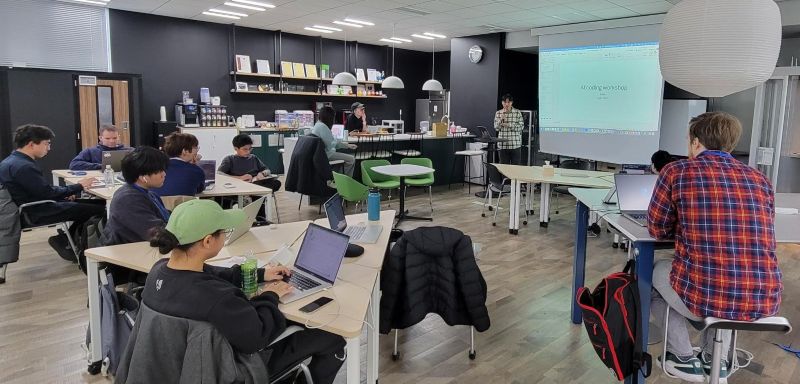
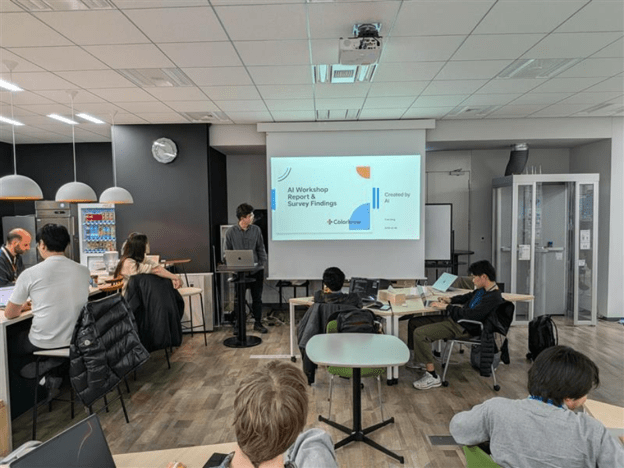
In early February 2026, we held a week-long workshop with a non-negotiable rule: whether you liked AI or not, you had to use it to write your code. I didn’t like the idea. I enjoy writing code with my own hands; I enjoy the thought process; I enjoy typing with Vim motions; I even enjoy the struggle of fighting with the lint errors. AI seemed to strip that away, replacing the ‘fun’ of coding with plain-language prompts. But it didn’t take long for me to be genuinely shocked by how far the technology has come. I assigned the AI a task that would typically take me half a day; it finished in under five minutes. Not only was it 95% perfect, but it handled edge cases I hadn’t even considered and matched our repo’s coding style flawlessly. I realized then that I could no longer afford to look the other way.
The ‘Brain Drain’ Trap
As I began offloading more tasks to the AI, I noticed a few troubling trends:
- Passive Thinking: I found myself engaging my brain less and less.
- Diminishing Returns on Joy: The ‘spark’ was fading. Reviewing AI-generated code isn’t nearly as satisfying as writing it, and checking off a ticket didn’t yield that same sense of satisfaction.
- The ‘Waiting Game’: I felt restless and unproductive in the gaps while waiting for the AI to generate a response.
- The Copy-Paste Loop: My workflow for complex bugs had devolved into a mindless cycle: I’d give the AI a prompt, it would ask for logs, I’d paste them back, and repeat. I had transformed from a thinker into a copy-paste machine.
In 2026, avoiding AI in software development isn’t really an option. Even the world’s fastest developer can’t outpace an AI that produces comparable quality in seconds. The real question isn’t if we should use it, but how.
Insights from the Engineering Team
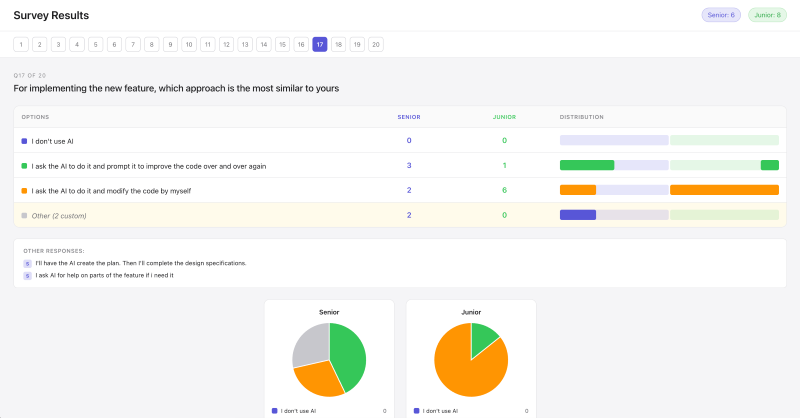
Since I didn’t have the answer myself, I conducted a survey among the engineers here at Colorkrew to gather their perspectives. I divided the participants into two groups: seniors and junior-to-mid-level devs.
My colleagues were kind enough to share their opinions openly, allowing me to draw a few key conclusions:
- Junior developers often feel a natural friction with AI. This stems from two main fears: that they’re losing their problem-solving “muscles,” and that their roles are becoming insecure. It’s a valid concern; AI is exceptionally good at the “clean, fast output” that traditionally defines a junior-level contribution.
- Senior developers often treat AI as a collaborator. They spend more time ‘chatting’, using plan modes or spec kits to refine implementation strategies and debate pros and cons. They treat the AI much like they would a human junior: focusing on the architectural plan rather than just the syntax.
- A Shift in Identity: I was surprised to find that many respondents are now comfortable writing almost no manual code. I used to associate this with ‘vibe coders,’ but I’ve realized that being a ‘real’ programmer is defined by your thought process, not how many lines you manually type.
Using AI at Colorkrew
After gathering these insights and using AI myself for two months, I’ve finally formed a vision for my own workflow. The secret lies in finding the right balance.
I can ask AI to plan a task, but I should never blindly accept its ideas; I can let AI generate a feature, but I will simultaneously simulate the logic in my own mind and conduct the code review with total scrutiny; I can ask AI to fix a bug, but I will continue to hunt for the root cause and consider edge cases in parallel. In a nutshell, my mantra is: It’s okay not to code, but it’s never okay not to think.
Even though I still miss using Vim motions all day, I have to embrace AI to keep pace with this rapid technological shift. At Colorkrew, we’re encouraged to leverage the best tools available—Cursor, Claude, Copilot, and more. The company covers the costs and gives us the freedom to use them however we see fit. We’re even encouraged to propose new AI use cases so the team can reach its full potential.
Crucially, the company has made it clear that junior evaluations aren’t based strictly on output. This prevents us from mindlessly chasing productivity at the expense of our personal growth.
Closing Thoughts
Reflecting on the past few months, I’m incredibly grateful for the opportunity to participate in this workshop. It served as the wake-up call I desperately needed, shaking me out of my ’no-AI utopia’ and forcing me to confront the reality of where our industry is headed.
My approach to AI is still evolving. It might not be perfect, or even ‘right,’ but since AI is new to everyone, we’re all on the same starting line. It’s a long-term journey, and I’ll keep searching for better ways to work. This is just the beginning of a much larger conversation about how we work and grow. I hope these reflections help you navigate your own path with AI, and perhaps give you a clearer sense of the forward-thinking culture we’re building here at Colorkrew.
Thanks for reading.
